
The Operational Challenges Facing Specialty Pharmaceutical and Therapeutic Clinics
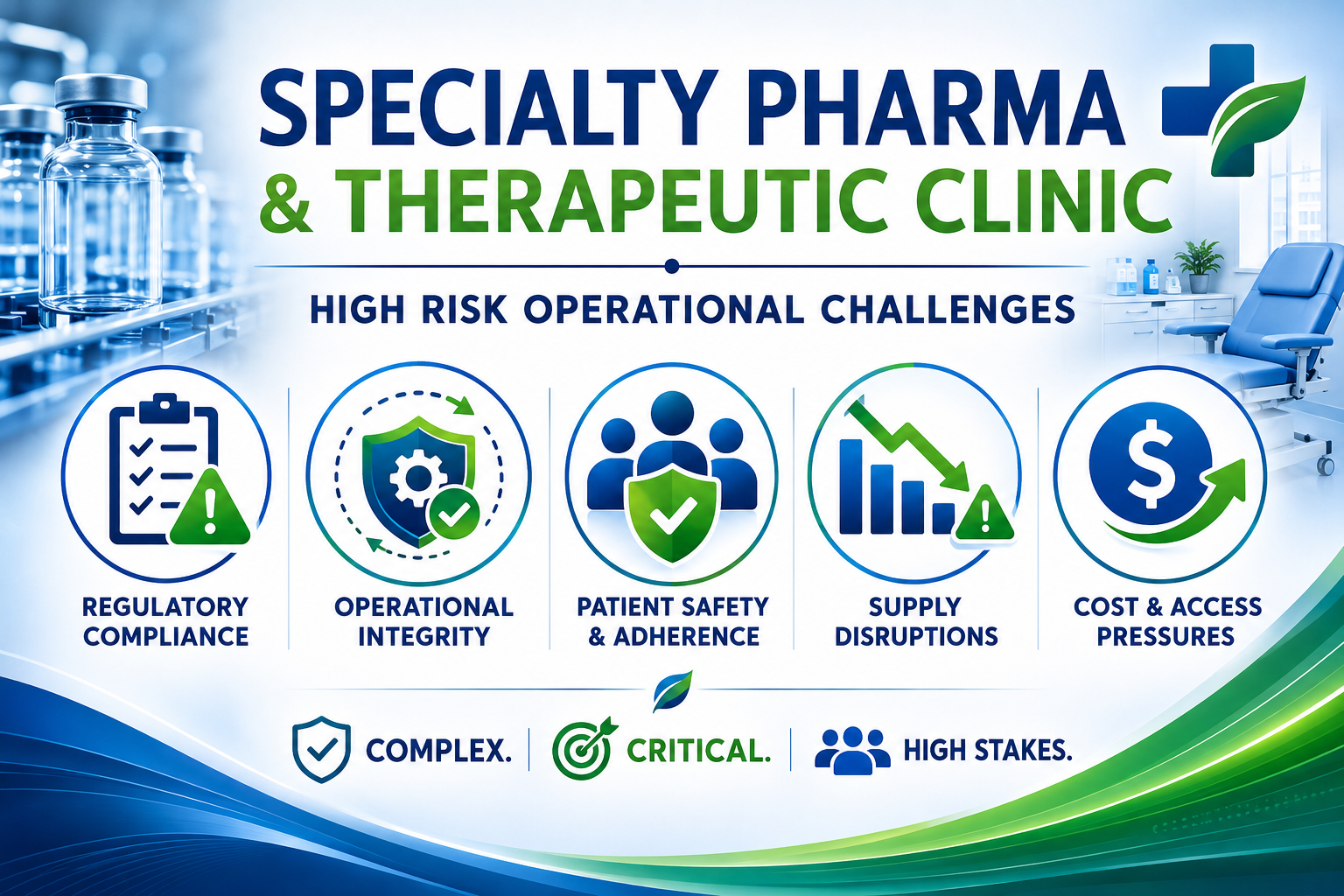
Why Rapidly Expanding Healthcare-Adjacent Sectors Are Entering a High-Risk Maturity Phase
Substantial Growth
Specialty pharmaceutical and therapeutic clinics have expanded rapidly over the past decade, driven by growing consumer demand for alternative therapies, compounded medications, metabolic treatments, personalized wellness products, and nontraditional care models.
The growth has been substantial.
But beneath the expansion, many operators are now encountering a more difficult reality:
Scaling medically-adjacent businesses are operationally far more complex than scaling traditional retail or consumer service models.
As these industries mature, organizations are increasingly facing pressure from:
- regulatory agencies
- payer dynamics
- patient safety expectations
- workforce shortages
- litigation exposure
- operational inconsistency
- Compliance complexity
- investor scrutiny
- consumer protection concerns
The result is an industry entering a critical transition period where operational sophistication is becoming just as important as growth itself.
Six Reasons Operational Clarity is Needed
1. Regulatory Complexity Is Increasing Faster Than Operational Readiness
One of the largest challenges facing specialty therapeutic operators is the speed at which regulation evolves compared to internal operational infrastructure.
Many sectors involving compounding therapies, wellness products, personalized treatment protocols, metabolic medications and alternative treatment models operate within fragmented regulatory frameworks that vary significantly by state licensing structure and medical oversight requirements.
This creates substantial operational strain.
Organizations often struggle to maintain consistency across documentation standards, credentialing, labeling compliance, marketing claims, consent processes and quality assurance systems.
The FDA, FTC, state pharmacy boards, medical boards, and consumer protection agencies have all increased scrutiny in areas involving therapeutic claims and compounded or wellness-oriented products in recent years.
Many organizations built for rapid expansion are now being forced to mature operationally under increasing oversight pressure.
2. Workforce Competency and Training Gaps
Another major challenge is workforce standardization.
Many specialty clinics operate in sectors where demand has outpaced the development of experienced talent pipelines.
In some organizations, frontline staff are expected to explain products or therapies with pharmacological implications despite limited formal medical or compliance training.
That creates risk.
Especially as consumers increasingly view these businesses as healthcare providers rather than retail operators.
As these industries mature, workforce competency standards will likely become a major differentiator between scalable operators and unstable ones.
3. Consumer Expectations Are Changing Rapidly
Patients and consumers are becoming significantly more educated.
Many now expect evidence-based guidance, transparent safety information, continuity of care and outcomes.
This is particularly important in sectors involving:
- weight management therapies
- compounded medications
- therapeutic formulations
- wellness optimization products
- biologically active supplements
Historically, some organizations relied heavily on marketing-driven growth strategies.
But long-term sustainability increasingly depends on clinical credibility and operational trust.
As public awareness increases, businesses without strong operational controls may face growing reputational exposure.
4. Adverse Event and Liability Exposure
One of the least discussed operational risks in specialty therapeutic sectors is liability escalation.
Many organizations underestimate the complexity involved when products or therapies involve overall body system metabolism, neurologic function, psychiatric symptoms or drug interactions.
Healthcare litigation trends consistently show that operational inconsistency becomes increasingly dangerous as organizations scale.
A business model that functions with one location may become highly unstable at ten locations without standardized governance systems.
5. Compliance and Operations Are Often Disconnected
In many rapidly scaling specialty clinics, compliance functions remain reactive rather than integrated into operations.
This is one of the most common structural weaknesses seen across emerging healthcare sectors.
Organizations frequently separate compliance from all other operations including marketing, HR and inventory management and clinical oversight instead of building unified operational governance structures.
The result is fragmentation.
Evidence across healthcare operations consistently demonstrates that disconnected governance models increase both regulatory risk and organizational instability.
Operational maturity requires integration, not departmental isolation.
6. Investor and Financial Pressure
Many specialty healthcare-adjacent sectors are now experiencing increased financial pressure from reimbursement scrutiny and uncertainty, tightening margins, rising labor cost and market saturation.
This creates tension between growth objectives and operational sustainability.
However, healthcare history repeatedly shows that underinvestment in operational infrastructure often becomes more expensive later through:
- litigation
- regulatory action
- turnover
- reputational damage
- scaling inefficiency
- acquisition barriers
The Industry Is Entering Its Operational Maturity Era
Many specialty pharmaceutical and therapeutic sectors are no longer early-stage industries.
They are becoming mature healthcare-adjacent ecosystems.
That transition changes expectations.
The organizations most likely to succeed long-term will likely be those capable of balancing:
- innovation
- patient safety
- operational structure
- regulatory adaptability
- workforce competency
- ethical growth
- governance discipline
- clinical credibility
The next phase of these industries will not be defined solely by consumer demand.
It will be defined by which organizations can operationally sustain that demand responsibly.
This is where operational infrastructure becomes a competitive advantage rather than an administrative burden. Systamedix Growth Solutions partners with clinics and therapeutic organizations to strengthen operational integrity, regulatory preparedness, workforce structure, compliance frameworks, and scalable governance systems. As these industries mature, organizations that build disciplined operational foundations now will be significantly better positioned to sustain growth, withstand scrutiny, and maintain long-term clinical and financial viability.